Architecture & concepts
How ade-ops is built, and the ideas that make it safe to operate by humans and agents together.
Core vs distribution
ade-ops has two tiers: a generic framework core and per-deployment distributions that build on it. A distribution never modifies the core — it consumes it.
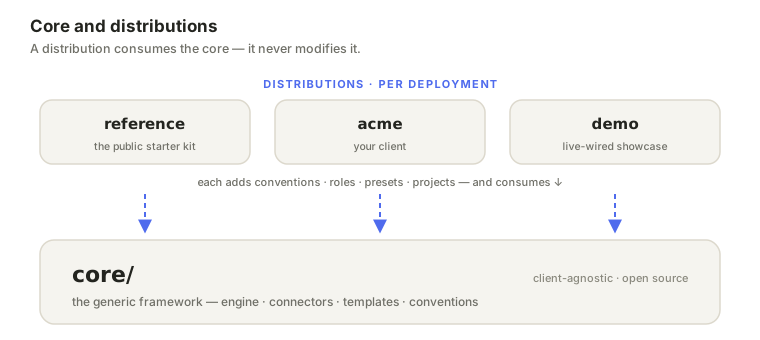
ade-ops/
├── core/                              # Generic, client-agnostic
│   ├── engine/                        # config / overlay / state / operations
│   ├── connectors/                    # Databricks, Fabric, Power BI
│   ├── conventions/                   # naming, sanitization, status protocol
│   ├── playbooks/                     # operational patterns
│   └── templates/                     # scaffolding for new projects
│
└── distributions/                     # Per-deployment customization
    └── reference/                     # The public reference implementation
        └── projects/<project>/        # Self-contained: src + overlays + state + config
Each project under a distribution is self-contained — its own config, credentials, overlays, and state — so it can be moved or detached independently.
The assembly pipeline (the contract)
The central idea: you author once in src/, and what gets deployed is the
result of layering environment config on top of it.
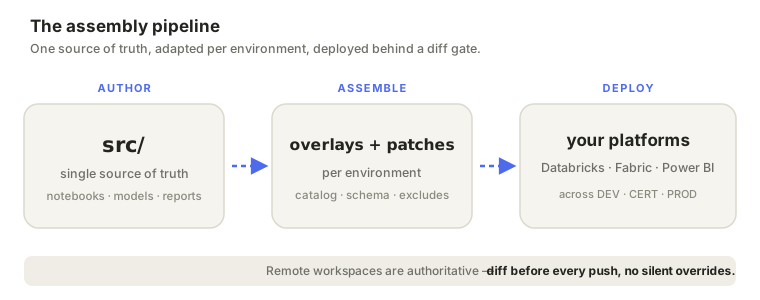
src/ (single source of truth)
  → overlays/{env}.yaml      (catalog/schema remap, text replace, exclusions)
    → patches/{env}/         (temporary env-specific overrides)
      → deployed to the remote
src/is where you author. It's the canonical version; environment differences never live here.overlays/hold declarative, per-environment transforms (which catalog, which schema, what to exclude) — not business logic.patches/are temporary per-environment overrides for the rare case an overlay can't express.state/mirrors what's actually deployed remotely. It is pulled, never hand-authored.
Four operations, one safety rule
| Operation | What it does |
|---|---|
pull |
Download remote state → state/{env}/ |
push |
Assemble src + overlay + patches → upload to the remote |
diff |
Compare assembled local vs pulled state |
status |
Overview: last pull, file counts, patch warnings |
Remote workspaces are authoritative, and every remote write is gated. Before
any push: assemble, show the diff against state, wait for explicit
confirmation, then upload. pull / diff / status are read-only with respect
to the remote.
The framework admits what it doesn't know
Two conventions keep trust calibrated:
- Skill maturity. Every skill carries a
status:field —experimental,preview, orstable— so you (and your agent) know how much to trust a given path before running it. - Honest converters. The notebook converters tag their output as
compat,light,heavy, orimpossible— the last two are explicitly your call, not the tool's.
Two deployment shapes
ade-ops runs in two operational shapes:
- Community / self-service (this open-source repo): you clone, run
onboarding, and operate your own instance. Updates arrive via
git pullfrom upstream; feedback flows via GitHub Issues and Discussions. - Enterprise (managed, not in this repo): a curated baseline that seeds
team deployments with naming conventions, guardrails, identity isolation, and a
CI/DevOps mirror — for multi-operator, governance-heavy teams. See
capabilities & tiers. If you're investigating an
enterprise deployment, open an issue tagged
enterprise-inquiryor reach the maintainer.
Built for humans + agents
ade-ops is usable from a plain CLI (python -m core.cli …), and that path is
agent-agnostic. It reaches its potential when paired with an AI coding assistant
that can drive its skills — Claude Code is the optimised path, with Copilot and
Codex supported at the CLI/recipe level. See the root CLAUDE.md / AGENTS.md
for the assistant conventions.